Nobody Taught China to Play Small. That’s Why They Won.
BYD. TikTok. Huawei. Belt and Road. This is what a 40-year challenger brand strategy looks like and what SEA founders can steal from it before the recession hits.
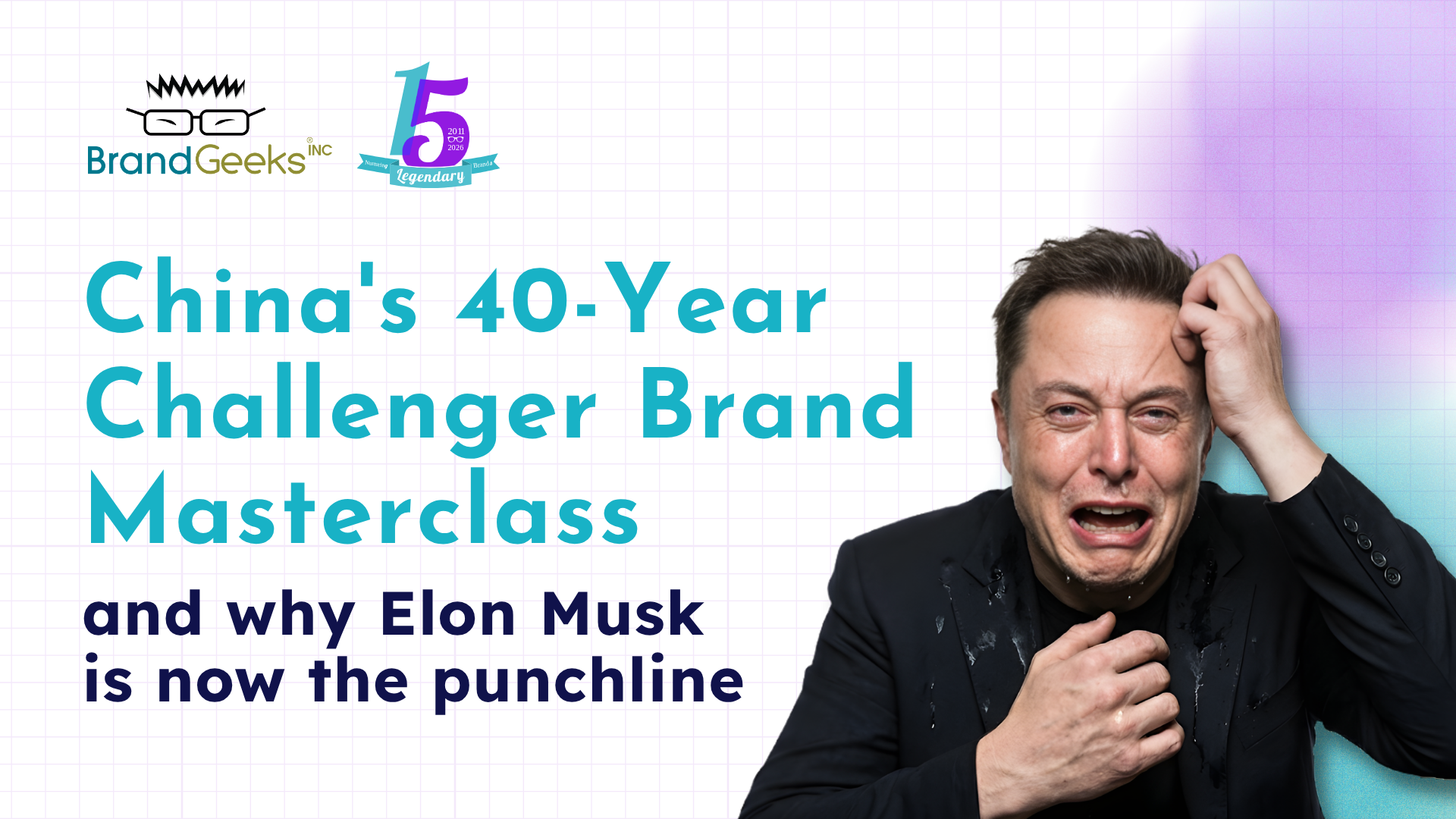
In 2011, a Bloomberg reporter asked Elon Musk what he thought of BYD as a potential rival to Tesla.
Musk laughed. Out loud. On camera.
Have you seen their car? I don't think they have a great product.
The technology is not very strong.
Thirteen years later, BYD outsold Tesla globally on electric vehicles. Musk, the man propped up by Trump, who turned the White House lawn into a Tesla showroom, is now begging for tariff protection so Chinese EVs don’t demolish the rest of the auto industry.
The punchline isn’t BYD. The punchline is Musk.
More importantly, the lesson isn’t about cars.
True North: Hold The Direction When Everyone’s Laughing
Every challenger brand has a True North. The non-negotiable direction you hold even when the big players are laughing at you.
BYD’s True North wasn’t “make a good car.” Their True North was: own the core technology first, then add everything else later.
They started with batteries. Not design. Not branding. Not marketing. Batteries. They went so deep into battery technology that by the time they decided to build a car around it, they owned the most important part of the supply chain that their competitors were still outsourcing. The design came later. The features came later. The affordability that made it a no-brainer purchase? That came from owning the most expensive component in the vehicle outright.
That’s not luck. That’s discipline. That’s a founder who knew exactly what hill to die on and refused to be seduced by the hills that looked more attractive.
Most founders I work with want to fix the logo before they’ve fixed the core product. They want to look competitive before they’ve become competitive. BYD did the opposite. They built the moat first, invisibly, unglamorously and let the world catch up.
Brand building is not about quick wins.
China has known this for 40 years. BYD held its True North for decades before Elon Musk stopped laughing.
The Long Game Is the Only Game
Deng Xiaoping said:
Hide your strength, bide your time.
That’s a 40-year Overcommitment Signal. You don’t announce the strategy. You execute it in silence while the big players dismiss you, laugh at you and assume their lead is permanent.
Huawei entered African and Southeast Asian telco markets that Ericsson and Nokia ignored, too small, too messy, not worth the overhead. They built trust in the markets others evacuated. By the time the US put them on the Entity List, they were so embedded in global infrastructure that the ban itself became the story. The sanction proved they mattered.
Belt and Road signed up 140+ countries not because of ideology but because China showed up with capital and built things when no one else would. That’s an Overcommitment Signal at sovereign level. You commit before the ROI is clear, before the optics are safe, before the Western press writes something nice about you.
Most brands hedge. China didn’t hedge.
TikTok: The Algorithm That Changed a War
The US tried to kill TikTok. They passed a law. They forced a sale. A consortium led by Oracle now controls TikTok’s US operations. ByteDance was pressured to reduce its ownership to under 20%.
But here’s what actually happened: ByteDance kept the algorithm. The soul of the platform. Oracle monitors it. The code was reviewed and retrained. But the underlying intellectual property, the thing that decides what a billion people see, stayed in Beijing.
They forced a sale and got the building. China kept the engine which did something that no amount of Western PR spend has managed: it shifted the moral narrative on Palestine. When the Gaza war erupted in October 2023, research from Northeastern University found that for every pro-Israel post on TikTok, there were roughly 17 pro-Palestinian posts and the ratio held two years later. The platform became the primary news source for an entire generation that didn’t trust CNN. The Zionists couldn’t stop it, because the truth was already everywhere.
Is this China’s doing? Directly? Hard to prove. But a Chinese-built platform became the infrastructure through which a suppressed narrative reached the world. And the US government, panicked, forced a sale that cost $14 billion and still didn’t get them the algorithm.
That is Cultural Momentum.
Ideas spreading faster than the marketing budget. The enemy trying to buy the platform and realising the platform is not the point.
The SEA Founder Question: Fight or Learn?
BYD is already in Malaysia. Xiaomi owns the mid-tier phone market. Mixue sells ice cream and bubble tea at RM4 a cup and is opening stores faster than most Malaysian F&B founders can count. Haier, Chery, Midea coming. All of them. With good design, good features and pricing that makes the purchase feel like a no-brainer.
Let me start with Mixue, because it’s the most instructive case study for SEA founders right now.
Mixue didn’t compete on quality. They didn’t compete on experience. They engineered a supply chain so tight, owning their own raw material processing, their own logistics, their own distribution, that they could sell a cup of ice cream for RM4 and still make money. Then they franchised it aggressively, keeping franchise fees low enough that a young entrepreneur in Seremban or Ipoh could open a store without serious capital. The franchisee does the marketing. The community does the word of mouth. Mixue does the supply chain.
That’s not a food brand.
That’s a distribution machine wearing a red-and-white suit with a cute snowman mascot.
So what do you do?
The wrong answer is “go niche, go deep, own your community.” That’s a retreat strategy dressed up as positioning. You’re not competing, you’re hiding in a smaller room and hoping they don’t find you. The right answer is:
Learn the structure, then beat them at it
with something they cannot manufacture.
Mixue’s structural weakness is identity. They can open 1,000 stores but they cannot own what it means to be from here. They cannot make a Malaysian mother feel proud when she buys her daughter a cup. They cannot carry a cultural story that this community holds with any genuine weight. Scale is their strength. Meaning is their blind spot.
Look at what three of our clients are already doing, not as theory, but as live proof.

Evenesis is a Malaysian event tech company that has been running and refining their platform since 2012. In 2023 alone they managed 725 events, including Oil & Gas Asia at KLCC with over 25,000 physical attendees. What keeps their enterprise clients is not just the software, it’s the deep integration, the institutional knowledge, the relationships built across years of delivery. Software with Service. A global SaaS platform scaling across ten ASEAN markets simultaneously will always optimise for the average use case. Evenesis has built for the specific, complex, high-stakes Malaysian enterprise client who needs a partner that picks up the phone, knows the venue and has already solved the problem they’re about to have. That’s not a feature. That’s a moat built from years of showing up.

Suncrox Solar is doing something that no Chinese solar company entering Malaysia will ever bother to do: electrifying off-grid indigenous communities, water villages, rural mosques and mobile clinics, under the mission “All for Solar, Solar for All.” Their founder Noor Shahiwan calls himself Chief Solar Warrior for a reason. They won the Mercy Excellence Award for Social Enterprises in 2015 and have completed over 4,000 installations. A Chinese solar company competing on panel efficiency and price has no answer for a brand embedded in a community’s survival story. You cannot win that with a lower tender bid.

Dapur Mama Original Nasi Kukus is taking original nasi kukus, one of the most beloved Malay comfort foods and building a franchise around it with the operational discipline of fast food. Not fast food that erases the soul of the food. Fast food efficiency in service of food that carries real cultural memory. Their signature pajeri nenas, the tangy, spiced pineapple curry that most Malaysians only eat at kenduri or their grandmother’s table, is on the menu. Their ayam berempah is fried fresh every hour. Not pre-cooked, not reheated, not optimised for cost reduction. Freshly fried. Every hour. That is a brand promise baked into the operational process. What Mixue did for ice cream, Dapur Mama is doing for Malay heritage food, but with an identity and a story that a Chinese F&B brand entering Malaysia will never be able to replicate. They are not just selling nasi kukus. They are elevating something they grew up eating at their mother’s table, for the entire community. That is an ideological position and ideology is armour.
These three are not hiding from Chinese competition. They are competing on an axis that Chinese brands entering ASEAN are structurally unable to win:
The precision of fit that only comes from being from the market, not just in it.
This is the playbook. Know your True North. Build the core capability nobody can buy. Layer on the identity only you can own. Hold it publicly and consistently for longer than feels comfortable.
The Chinese brands coming into Malaysia are good. Some of them are very good.
Nobody taught them to play small either.
But they cannot be you. They cannot carry your story, your community, your cultural memory, your decades of showing up in places that didn’t show up on anyone’s growth forecast.
Elon Musk laughed at BYD in 2011.
Someone is laughing at you right now.
Good. Let them.
When a true challenger brand is being laughed at, the competition just hasn’t realised they’re already losing.
Attend our upcoming TurbochargeMyBrand™ Challenger Brand Bootcamp. Find out where your Purpose & Promise is shaky, where your enemy is unnamed, where your ideology is thinner than you think and where your cultural momentum is basically zero. Then let’s fix it.
- 2-day live online bootcamp.
- Challenger Brand Identity + Positioning + Activation.
- Find your own brand voice, in the room and not as homework.
- Powered by the TurbochargeMyBrand 3-Part Canvas.
About the Author

Silmyi M. Sadek is the founder, dreamer and creative force behind Brand Geeks Inc. Determined to establish a firm that pushes boundaries and creates impact, he brings with him years of extensive experience in the legal field, post-graduate education in branding and marketing, brand consultancy and design expertise, tech affinity and start-up experience for the single purpose of nurturing legendary emerging brands.
Regarding Brand Geeks Inc
Since 2011, Brand Geeks Inc has helped brands evolve into tech-empowered market leaders. We’ve guided 300+ brands, including MyTeksi (before it became Grab), to turbo growth. We don’t just nurture legendary brands that change the world, we nurture the people who build them. Explore our portfolio and services at brandgeeksinc.com
What They Said About The Program

The session was informative & provided a lot of updated insights on current AI trends & users, especially in Malaysia.
Adelyn Ghwee
Kloth Circularity

There are so many AI tools we haven’t explored yet, this masterclass helped me see that.
Siti Sarah
Durioo+

It’s not just about marketing, this experience was more about the entire journey of your startup.
Kishendran Annamalai
TaskPhase

AI is a new thing, Tak ramai yang ada masa untuk explore secara berstruktur, sebab kelas ni dia offer silibus yang berstruktur.
Abdullah Abbas
Mesolitica

The biggest thing is, the introduction to the multiple AI platforms, sometimes those are the ones that I havent tried yet.
Faris Imadi
Lekir Tech
If you’d like our help: Get our consulting services for your branding needs; email [email protected].